
Back to the Future
The loophole in Divino Afflatu that allows the return of the Roman Psalter for even the most scrupulous papal maximalists

IV Idus Martii (12 March) Anno Incarnationis MMXXVI
The Feast of Saint Gregory the Great
I will begin this post by saying that I do not agree in any way shape or form with the notion that the pope of the moment has either the power or the authority to definitively forbid any liturgical rite or custom which has been received by the Church since time immemorial and has been unanimously endorsed by his predecessors throughout the centuries. That opinion is not only entirely incoherent and absurd - but fundamentally non-Catholic.
That said, I also understand that the modernists, both the left wing variety who hold positions of power in the Vatican, and the right leaning modernists who dominate the various sedevacantist sects, who have dominated Catholic life for the last century have unfortunately so inculcated the idea in the minds of Catholics that the pope of the moment is omniscient, omnipotent, and free to lay waste to any long held Catholic tradition that pleases him that many are no longer able to distinguish truth from falsehood in this matter.
This unfortunate phenomenon has led to a serious case of scruples in the hearts of many priests and even laity concerning the millennial song of the Western Church that is the Roman Psalter. The supposed ban on this wondrous gift of God implemented by ‘Saint’ Pius X in Divino Afflatu has placed the Roman Psalter in an off limits box that is not to be touched even in case of emergency by even the most ardent so called ‘traditionalists’.
And even those who have doubts about this ban generally keep their mouths shut and let their scruples take over, and continue to enforce this ban. But actually none of this is necessary. The letter of Divino Afflatu turns out to have been so clumsily and sloppily written that it left a rather large loophole that the Roman Psalter is able to make a soft landing and return to the life of the Church - for all those who are willing to let it.
The so-called ‘ban’
Here is the passage where ‘Saint’ Pius X forbids, or at least attempts to forbid, the clergy from using this age old gift from heaven:
Itaque, harum auctoritate litterarum, ante omnia Psalterii ordinem, qualis in Breviario Romano hodie est, abolemus eiusque usum, inde a Kalendis Ianuariis anni millesimi nongentesimi decimi tertii, omnino interdicimus. Ex illo autem die in omnibus ecclesiis Cleri saecularis et regularis, in monasteriis, ordinibus, congregationibus, institutisque religiosorum ab omnibus et singulis, qui ex officio aut ex consuetudine Horas canonicas iuxta Breviarium Romanum, a S. Pio V editum et a Clemente VIII, Urbano VIII, Leone XIII recognitum, persolvunt, novum Psalterii ordinem, qualem Nos cum suis Regulis et Rubricis approbavimus typisque Vaticanis vulgandum decrevimus, religiose observari iubemus.1
Therefore, by the authority of this letter, and before all else - we abolish the Order of the Psalter as it is today in the Roman Breviary and forbid its use in all things from the Kalends of January of the year one thousand nine hundred and thirteen. We command that from that day the new Order of the Psalter that We have approved with its Rubrics and Regulations (which will be published by the Vatican press) be strictly observed by each and every person in all churches of both religious and secular clergy; in monasteries, orders, congregations, and religious institutes who are under obligation, either by duty or custom, to recite the canonical hours according to the Roman Breviary put forth by Pius V and revised by Clement VIII, Urban VIII, and Leo XIII.
The language of Divino Afflatu is very specific here. And in this very specific language Pius X very specifically bans the Breviary of Pius V and the order of the Psalms contained therein. Now why is that important? Because, strictly speaking, in 1911 the Breviary of Pius V was not the only licit breviary for the clergy to pray.
The multiple options of 1568
We all remember that 350 years before Pius V had issued his famous 200 year exception in 1568 whereby he mandated that his breviary be used by the entire Church- except by those who could prove that their breviary had a longer than 200 year pedigree. Here is the specific language from Quod a Nobis:
Ac etiam abolemus quaecumque alia Breviaria vel antiquiora vel quovis privilegio munita vel ab Episcopis in suis Diocesibus pervulgata omnemque illorum usum de omnibus orbis Ecclesisis, Monasteriis, Conventibus, Militiis, Ordinibus, et locis virorum et mulierum etiam exemptis in quibus alias Officium divinum Romanae Ecclesiae ritu dici consuevit aut debet: illis tamen exceptis quae ab ipsa prima institutione a Sede Apostolica approbata vel consuetudine quae vel ipsa institutio ducentos annos antecedat2
And we abolish as well whatever other Breviary - whether older,3 or in any place protected by privilege, or promulgated by bishops in their own dioceses - and all use of them from every church, monastery, convent, and military or religious order -even those exempt communities of men and women who have heretofore customarily said the Divine Office according to the rite of the Roman Church; those being excepted that from their first institution have been approved either by the Apostolic See or by custom - and from that institution at least two hundred years have passed
So there it is. After 1568 one had the choice of breviary between that which Pius V produced in that year, and any other breviary which had been approved by the Apostolic See or by the custom of continuous use prior to 1368. And there were a great number of breviaries produced prior to 1368 that were still in use in Europe during the last quarter of the sixteenth century.
The problem is that, for whatever reason, during the latter part of the 16th century everyone was in a rush to align themselves liturgically with Rome; and many ancient local and regional variations were abandoned4 in favor of the Breviary of Pius V. Unfortunately, by the middle of the seventeenth century the only groups still taking advantage of the 200 year exception were religious orders such as the Dominicans and, of course, the Monastic breviary which is, and remains, a world unto itself.
Yet there is no record in any place or any time of any attempt by any Ecclesiastical authority to abrogate Pius V’s recognition of the rights of these ancient breviaries. None whatsoever.
The rise of Modernism
Over the next quarter of a millennium, however, things became more and more centralized around Rome, and the ancient custom of liturgical localism surrounding a fixed center, which Pius V had attempted to preserve, was largely forgotten. The only outbreak of localism during this long period was the weird century and a half experiment in France with the Parisian Breviary of 1736.
But that Breviary neither drew from the past or from any solid liturgical tradition. Rather, it was pure innovation that was continuously and forcefully condemned by the Roman Pontiffs for 170 years5- until outside forces manipulated the 1903 Conclave to force the modernist Giuseppe Sarto on the Church as Pontiff, who used that proto-modernist creation as a template for his so called ‘reform’ of the Roman Breviary in 1911. Which is why it is so offensive to see Pius X held up by right leaning modernist groups who masquerade as ‘traditionalists’, such as at least some in SSPX but much more prominently in the various sedevacantist sects, and who constantly parade him about as if he were some great defender of the Catholic religion - when absolutely nothing could be further from the truth.
In any case, by 1911 the actual ancient breviaries had long fallen into disuse. From what I can see the two hundred year exception recognized by Pius V seems to have almost entirely forgotten by that time. If it was remembered at all it seemed only to manifest itself as the idea that the older religious orders, such as the Dominicans, had the clout to at least force the pope to take their opinion into account.
Yet for all that: the legal permission for a cleric to fulfill his obligation regarding the Divine Office by reciting a Breviary which had been approved prior to 1368 had never been abrogated by anyone. It had fallen so far into disuse that no one even bothered to dig it up in an attempt to overturn it. And so it remains today.
The modernist sloppiness of Pius X’s cronies
Now the astute reader might ask here: ah… but did not ‘Saint’ Pius X in 1911 first, foremost, and beyond all else forbid clerics and all those under obligation to pray the Divine Office from praying the order of the Psalms found in the Breviary of Pius V? And would this provision, in and of itself, not negate any possibility of any cleric in 2026 using a breviary produced prior to 1368 - since said breviary would have to contain the forbidden order of the Psalms and thus be rendered out of bounds?
Well... actually… no… it wouldn’t. Because, you see, in 1568 when Pius V produced his new breviary he did, in the most minimal way, tweak the order of Psalms with regard to the Hour of Prime. In the Roman Office Sunday Prime has always been a quite long Office with Psalms 21-25, 53, 117, and two parts of 118 all being recited in that single hour along with the Athanasian Creed. In Pius V’s 1568 Breviary, however, Psalms 21-25 were removed from Sunday and distributed throughout the week to be sung at the various ferial Primes - thus constituting an ever so slightly, but nonetheless different order of Psalms from the actual Roman Psalter that would be found in a breviary produced prior to 1368. And it is this latter (1568) order of Psalms that the language of Divino Afflatu forbids - and nothing else.
And so, since the modernist buffoons who wrote Pius X’s Divino Afflatu, overjoyed as they must have been to finally have a pope who would adhere to their wishes, got a little excited, a little ahead of themselves, and were not very precise in their language… any breviary produced and approved prior to 1368 remained then, and still remains now, a perfectly valid way for any cleric or any person bound under obligation to recite the Divine Office to fulfill their obligation.
God really does have a terrific sense of humor.
Back to the future
And yes, today it is still possible to find a breviary published and approved prior to 1368. Digitized manuscripts exist of breviaries going back to the close of the eleventh centuries. The challenge is to choose a suitable manuscript of a suitable breviary which can be transcribed and typset in order to consummate a printed volume that can be held in the hand.
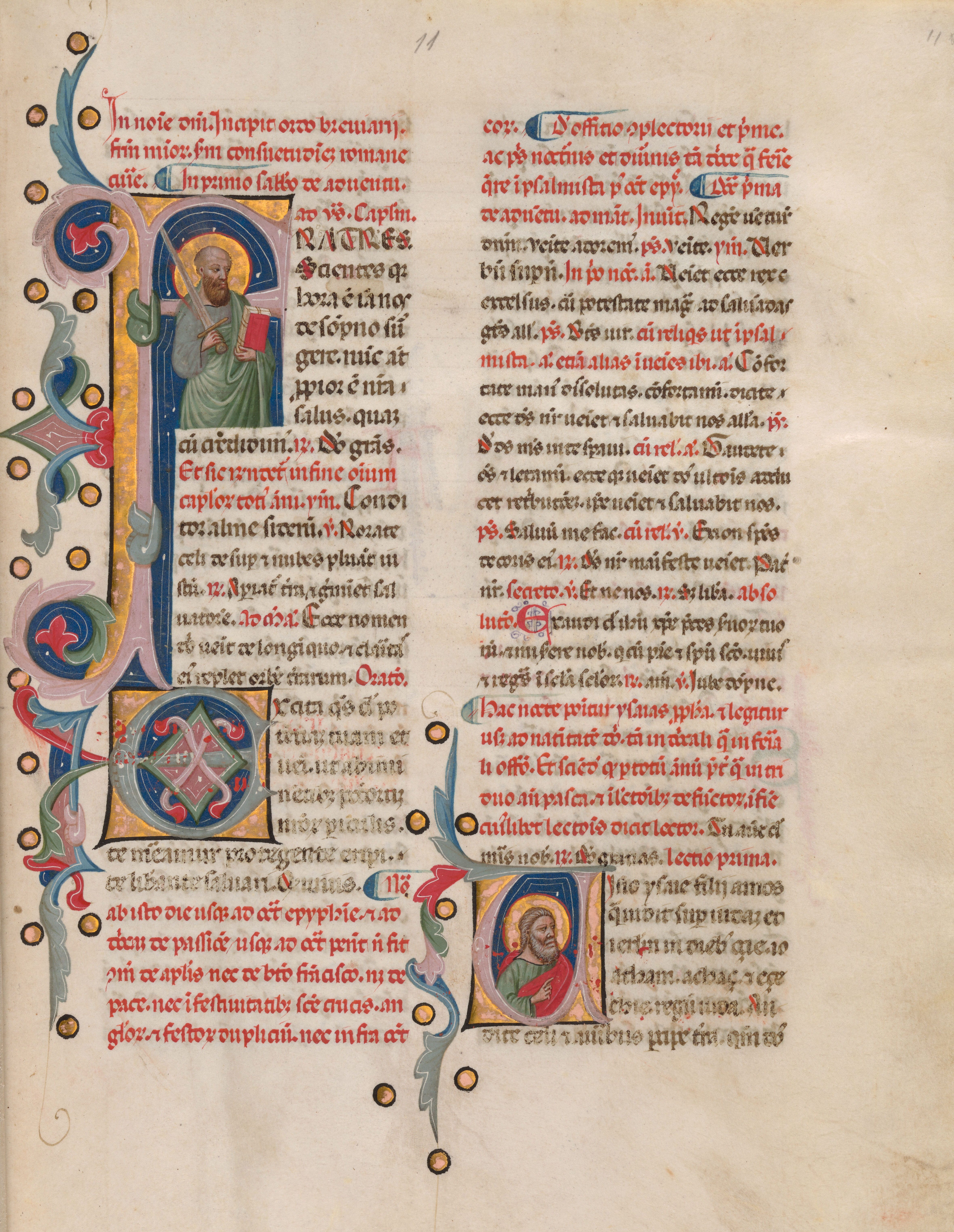
Here the Franciscan breviaries are the safest bet, since it was an integral part of the identity of the Friars Minor to closely adhere to the liturgical tradition of the Roman Curia. And since the breviary of the Roman Curia was the pope’s own breviary, it makes approbation by the Apostolic See a foregone conclusion. As can be seen above, the opening words to the Franciscan Breviaries of the period were as follows:
In nomine Domini: Incipit ordo breviarii fratrum minorum secundum consuetudinem romanae curiae.
The above image comes from a digitized manuscript of a Franciscan breviary which has been judged to have been produced at the very latest in 1350. This dating would make it at the very least at 218 years old when Pius V promulgated Quod a Nobis in 1568, and therefore fully compliant with the laws and norms of the Apostolic See, for even the most scrupulous, as regards fulfilling ones obligation concerning the Divine Office.
Its images are all downloadable and it is free of any known copyright restriction. So, the goal here would be to organize all the slides, transcribe the text (AI can be extremely helpful here with the gothic script), get the transcription typeset, and turn it into a physical volume. None of these things are easy; but they are possible. And in the digitally interconnected world of 2026 this project is infinitely more doable than it would have been thirty, forty, or fifty years ago.
So, again, as I mentioned in the last post, if anyone has any interest in making this happen and/or any knowledge or skill in the areas mentioned above, and is willing to offer guidance or assistance of any kind please comment or DM me.
The time has now long passed to stop complaining and start doing something, and here here is a place where we can act. The calendar is the foundation of a civilization, and how a civilization marks the hours of the days, the days of the week, and the months of the year is its largely unseen, but ever present, skeletal frame. And it was the Roman Office that provided that skeleton for the entire Western world, and united all the lands from the Atlantic coast of Portugal to the Pripet marshes as a unified civilization in the Catholic religion for fifteen centuries.

To restore the Roman Office to regular and, God willing, widespread use would be to infuse the hours of the days, days of the week, and months of the year with the worship of God and the memory of his saints. It would be the construction of a new Christian polity, just as surely as the weakening of the Roman Office during the 18th and 19th centuries, and its final destruction by Pius X in the 20th, led to decimation of the old.
Or we can just do nothing as the world burns around us… and keep whining about Vatican II.
Divino Afflatu does not include paragraph numbers in the text. This particular paragraph is the third paragraph from the last. The Latin text of DA is available here. The English translation is mine, but an independent English translation of Divino Afflatu, done by Romanitas Press, is available here.
The text of Quod a Nobis is unfortunately not widely circulated on the internet. There is an English translation of the Bull here which I think comes from a translation of Dom Gueranger’s the Liturgical Year, but the translation of the 200 year exception is not very well done. The translator seems to have gotten confused about the meaning of the word ‘vel’ and does not seem to have been aware that in this case it is being used as a synonym for ‘saltem’, or ‘at least’, which is the only way the sentence makes sense.
Pius V had in the previous lines abolished by name the Quignonez breviary of 1536, which is what he is referring to when he uses the word antiquior, or ‘older’. In other words, the ban he was about to promulgate also applies breviaries produced prior to 1536, based on the criteria he lays out in this section.
History of the Roman Breviary, Pierre Batiffol, 1912, pp. 206-07
The Roman Pontiffs condemned the Parisian breviary, but it was strangely defended by the French kings who would end up paying a bitterly for their taste for innovation here. Oddly enough it was only with the full return of French Republicanism post 1870 that the French church returned to full unity with Catholic custom when in 1875 the Diocese of Orleans became the final French diocese to abandon the 1736 breviary and return the Roman use.
Regarding clerics who have doubts on this ban, Bp. Athanasius Schneider is one of them, as at least once called the Roman Cursus the 'Breviary of the Ages'. But as it those in power are not interested in the Divine Office at all, let alone reverse Divino Afflatu's legacy.
It is interesting to note that the 'Wrath of Peter and Paul' as found in Quo Primum, is directed NOT at clerics who pray some other Missal, but to anyone who modifies the decree *itself*, with additional penalties for printers who edit the Tridentine Missal, in stark contrast to Divino Afflatu, which directs the Apostles' Wrath at anyone who doesn't use the new Breviary past 1913. Quite the disconnect in the use of the keys of Peter.
But by 1911, the Carmelites, Praemonstrantensians, and Dominicans did not feel themselves excepted by the 200-year rule and quickly organized commissions to put DA into effect (as testified by Bonniwell in his "History of the Dominican Liturgy", pp367), even if the decree itself had sloppy language. Contrast that to Urban VIII's hymn reform, in which every place justified rejection by reason of Quod a Nobis (not Quo Primum, to correct this common mistake by trads).
Another consequence of whole Neo-Gallican affair is the unfortunate message it broadcasts, as the Parisian Breviary was rightfully condemned, not because the French bishops (of their own accord) modified their rite, but because it modified the ancient psalter distribution, to which the message from Rome wasn't, "don't mess with tradition", but, "only Rome can mess with tradition", to which was the message popes have heeded since.
Regarding transcription and AI, my 1256 Dominican Breviary is around ~30% complete, but should I devote a whole two months to it, it should be more or less ready for print. I would like to extend a hand to anyone looking to do other transcription projects, e.g. the Roman Breviary proper. If someone put all the texts into a giant text file, and grabbing the transcribed rubrics and texts from DivinumOfficium, I could help by formatting it into a PDF.
For medieval handwritten MSS, my brief testing has shown that Gemini and Claude AI's can handle medieval handwriting and produce accurate transcriptions, at least with the sample I had prepared (the Dominican Breviary). ChatGPT has simply hallucinated nonsense in my experience, and I can't really say for any other AI models.
It's a shame that most of the religious orders (outside of the ones using the St. Benedict Psalter) caved in. Among others, the Dominicans and Carmelites were pretty painful, because they kept their original pre-Tridentine Psalter up to Pius X; all they needed to do was reduce the number of Doubles and Semi-double feasts, and have Sunday Long Prime again for all Sundays. Instead, they fell to the hype about a newer, better Psalter, and took the Divino Afflatu Psalter as their own in their reform happening (probably a few years later)