


The Octave of the Ascension
A forgotten detail in the Church's liturgical life

XVII Kalendas Iunii (16 May) Anno Incarnationis MMXXIV
The Octave of the Ascension
The Octave of the Ascension is a now forgotten gem of the liturgical year To some commentators it has seemed that it was sensible to remove1 it from the clerical breviary during the last years of the pontificate of Pius XII. They argue that it is of a fairly late date or something like that2 so that it was fine that Pius XII got rid of it.
But how old is the Octave of the Ascension? I have no idea. I don’t actually think anybody3 knows. Octaves are notoriously difficult to find in the ancient service books of the first millennium, whether the Sacramentaries for the Mass or some sort of Divine Office manuscript. This is mostly because the Octaves are repetitive and with a couple of exceptions4 basically repeat the same Office every day. So in the ancient handwritten manuscripts they were not going to waste time, space, and effort rewriting everything, or even anything at all, when everyone knew (and in that era absolutely everyone did know it) that you just repeated the Office or the Mass of the Feast Day eight days in a row.
And this is especially true for the Octave of the Ascension because nothing5 changes, save the lectios at Matins. Everything else is exactly the same every day. The antiphons at the Benedictus and the Magnificat, the Oratio, everything. The only way that one might identify an Octave of this type in sources from the pre printing press era is possibly in some sort of liturgical calendar but in this case since the Ascension is a moveable Feast it won’t be found there either. So it really is impossible to say how long it has been there. It very well may have its origin in one particular place and ended up catching on in others before finally becoming universal, or it may have been more or less universal from the start. We just don’t know.
But this Octave is right and proper and should not have been eliminated for several reasons. First is the mammoth importance of the event itself. The Ascension of Our Lord brought you and me6 beyond the choirs of angels and all of the ethereal heavens straight into the unfathomable bosom of the Most Holy Trinity. And that should be something that nobody has any problem celebrating and offering thanksgiving for for eight days – eight being the number of eternity after all.
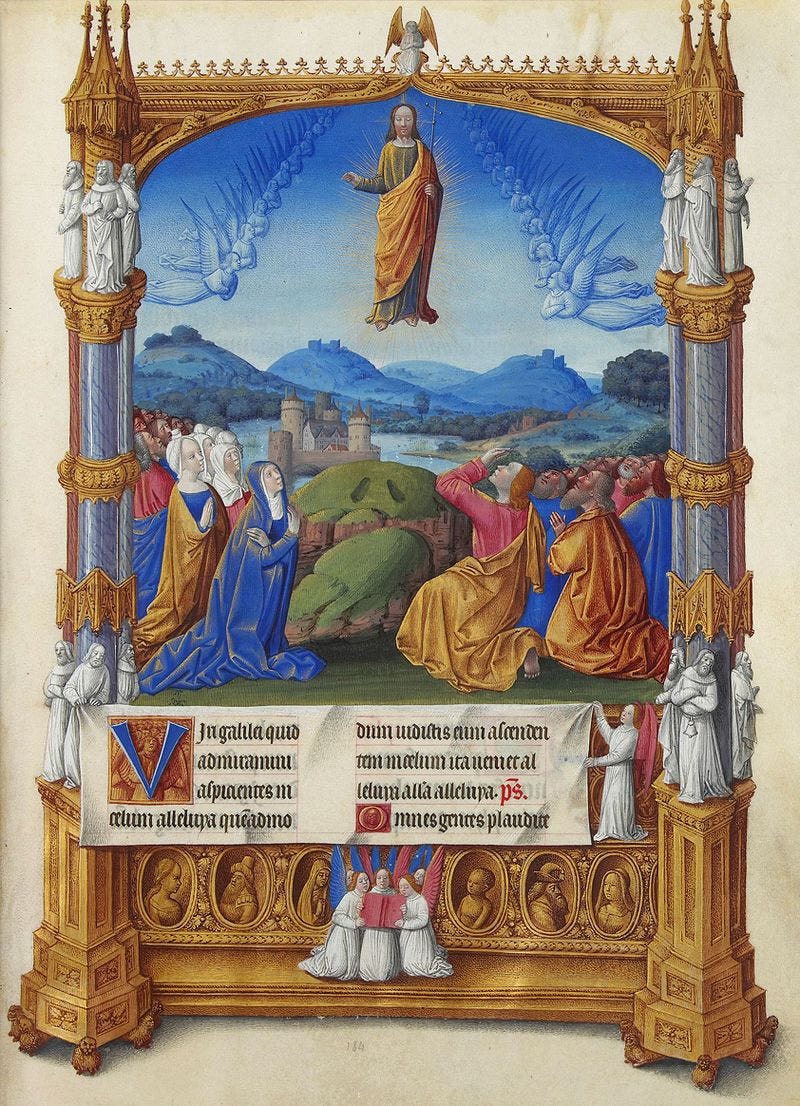

Secondly, along with the Pentecost Octave it creates a similar effect to the combined octaves of Christmas and Epiphany in that during all the time stretching between Ascension Thursday and Trinity Sunday, two and a half weeks, the regular weekly Psalter is not said. This creates a sort of barrier between the seasons and marks a serious transition in the liturgical year. When one finally concludes the Octave of Pentecost the habits formed around the Offices of Easter have usually definitively passed away and we are ready to enter into the new phase of the time after Pentecost.
Thirdly the anticipation of the coming of the Holy Spirit at Pentecost. The waiting. The reminder that Our Lord did make us a promise and He most definitely will fulfill it. After the glory of the Ascension itself this is the chief function of the Octave. Witness the antiphon of Second Vespers of the Feast that is repeated during each day of the Octave:
O Rex gloriae Domine virtutum qui triumphator hodie super omnes caelos ascendisti ne derelinquas nos orphanos sed mitte promisum Patris in nos Spiritum veritatis, alleluia
O King of glory, Lord of Hosts - the Vanquisher who did this day ascend over all the heavens! Do not leave us orphans but send to us the promise of the Father: the Spirit of Truth, alleluia!
Or the following section of a respond at Matins read following lectio iv:
Rogo pro vobis Patrem ut ipse vos custodiat alleluia alleluia! V. Nisi ego abiero Paraclitus non veniet cum assumptus fuero mittam vobis eum.
I ask the Father on your behalf that He Himself may keep guard over you alleluia, alleluia! V. Unless I go away the Paraclete will not come. When I am taken up I will send Him to you.
Or again, following lectio v:
Non turbetur cor vestrum ego vadam ad Patrem et cum assumptus fuero a vobis mittam vobis alleluia * Spiritum veritatis et gaudebit cor vestrum alleluia. V. Ego rogabo Patrem et alium Paraclitum dabit vobis. Spiritum veritatis et gaudebit cor vestrum alleluia.
Do not let your hearts be disturbed I am going to the Father and when I am taken up from you I will send to you alleluia * the Spirit of truth and your heart will be glad alleluia. V. I will ask the Father and He will give to you another Defender. The Spirit of truth and your heart will be glad alleluia.
This wonderful prayer for the Holy Spirit will soon be fulfilled and the world will never be the same.
The Octave of the Ascension suffered a similar strange fate to that of the Octave of the Epiphany in 1955. It was like they got rid of it - but they knew they shouldn’t be getting rid of it so they left it, but they didn’t really leave it.
Instead they turned into ‘Tempus Ascensionis’ or the Time (or even season) of the Ascension. A nine day season. The proper Psalms of the Octave and their antiphons disappeared and were replaced by Pius X’s ferial Psalms and antiphons but everything else remained except that of course in the style of the era the readings at Matins were reduced from nine to three which cut out some absolutely gorgeous Patristic homilies and the repeated reading of the conclusion of the Gospel of Mark at the commencement of the third Nocturn.
Another argument could be that the Friday and the Saturday (the Vigil of Pentecost) following the Octave Day that bridge the gap until Pentecost kind of kill the culminating effect that an Octave Day is supposed to have since they more or less revert to the form of Office that was said prior, during the Octave itself, and you kind of scratch your head doing that. But oh well, that is one of those weird liturgical oddities that in all honesty ends up being much more charming than deleterious.
I cite here two different articles from the ‘traditionalist’ blog OnePeterFive that give dates for when the Octave was supposedly put in place that are six centuries apart. The first a very recent article written by a priest of internet fame Father John Zuhlsdorf which claims (citing no source) that the Octave wasn’t introduced until the 15th century so it was ok that Pius XII got rid of it.
And another article from the same website written a year earlier by Matthew Plese claims, again citing no source, that the Octave was attached to the Ascension by Pope Leo III who served from 795-816, six hundred years earlier than Father Zuhlsdorf’s equally unsourced claim.
Garbage like this does no credit to nor will it contribute anything toward the restoration of the Church’s liturgical heritage - in fact it does quite the opposite. The Editor should do a serious examination of conscience.
Easter and Pentecost have proper antiphons at the Benedictus and Magnificat and a proper Oratio for each day of the Octave.
Save of course for Sunday.
If we choose to follow Him